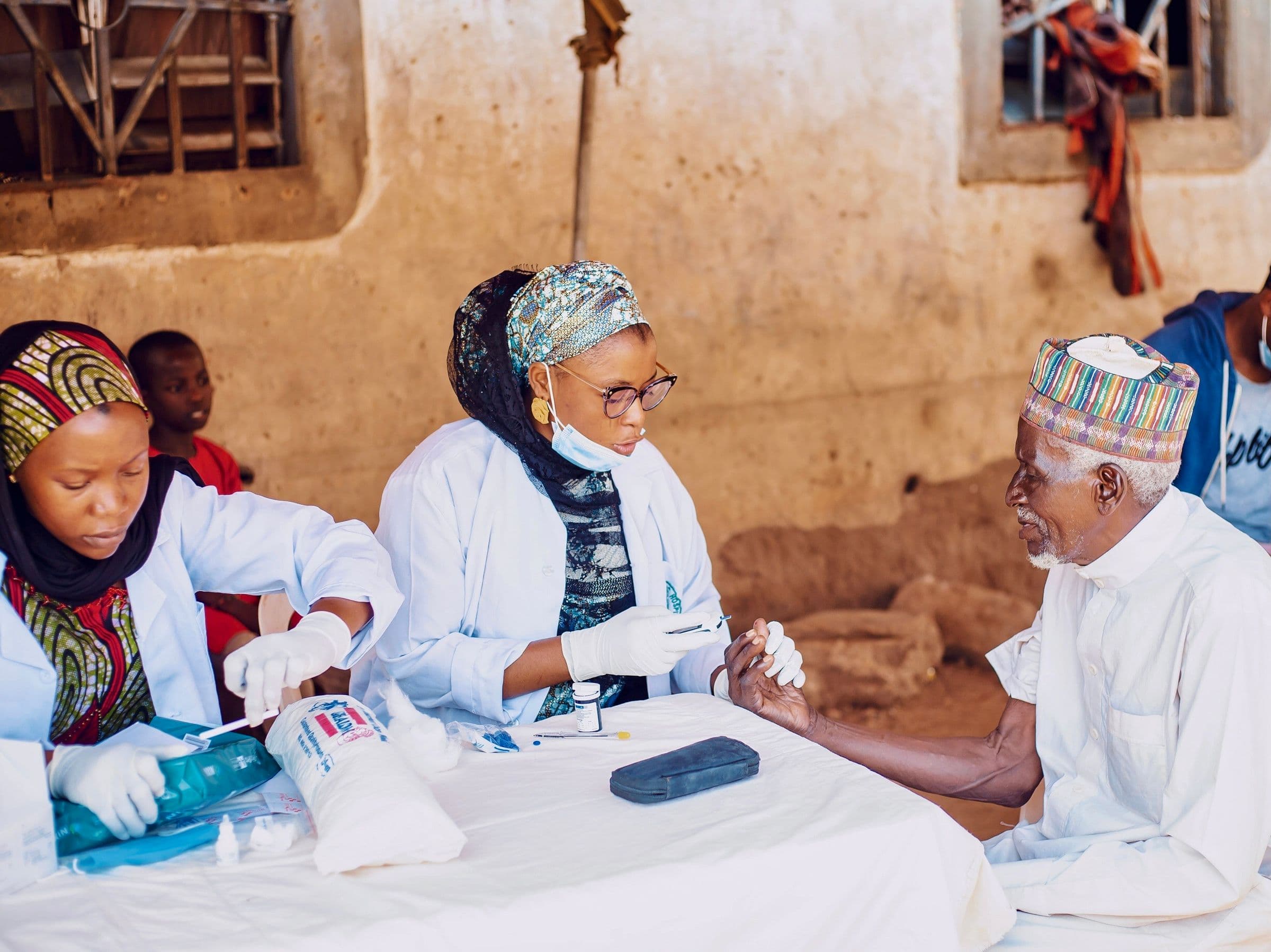

At our core, we are driven by a simple but powerful belief: technology should serve people, not the other way around. Our organization brings together expertise in health sciences, artificial intelligence, data analytics, and public health research to address some of the most urgent healthcare challenges of our time.
We work at the intersection of health, data, policy, and innovation. This allows us to ensure that insights generated from advanced analytics are not only scientifically rigorous, but also ethical, context-aware, and responsive to real human needs. Every project we undertake is grounded in compassion, guided by evidence, and designed to deliver measurable impact.
Our approach emphasizes translation. We do not stop at discovery or analysis. We focus on ensuring that research findings move beyond academic spaces and inform policies, programs, and interventions that improve lives.
Despite unprecedented growth in health research and digital health systems, critical gaps persist that limit the effectiveness of healthcare delivery worldwide.
Healthcare providers and decision-makers lack timely, research-backed evidence, slowing effective responses and policy decisions.
Limited access to timely, research-backed evidence hinders rapid health responses and sound policy decisions.
Limited access to data and technology drives unequal disease burdens and weakens health systems.
Delays in translating research into practice limit impact and leave communities waiting for existing solutions.
Our core focus areas define how we apply data, NLP, and research to address critical health challenges.
We conduct interdisciplinary research that combines data science, epidemiology, and health systems research to inform evidence-based interventions and policies.
We design and deploy ethical AI solutions that address health disparities and support equitable access to healthcare insights and services.
We empower individuals and institutions with skills in bioinformatics, NLP, and health data science through structured training and open educational resources
We develop and apply natural language processing techniques to analyze unstructured health data such as clinical notes, medical literature, health surveys, and patient feedback, unlocking insights that traditional methods often miss.
We transform complex health datasets into actionable intelligence for researchers, healthcare providers, policymakers, and organizations through advanced analytics and visualization.
Using NLP, data science, and health research, we turn complex data into actionable, real-world insights.
We built a data analytics framework that supports population health monitoring and evidence-based decision-making.
By applying advanced NLP to biomedical literature, we enable faster evidence synthesis and access to critical insights.
Our data-driven research addresses public health challenges in underserved communities, prioritizing ethical, locally relevant and practical solutions.
We advance knowledge at the intersection of health, data science, and language technologies through publications, reports, and policy analyses for scientific and public audiences.
In recent years, multilingual pre-trained language models have gained prominence due to their remarkable performance on numerous downstream Natural Language Processing tasks (NLP).
Despite the recent progress on scaling multilingual machine translation (MT) to several under-resourced African languages, accurately measuring this progress remains challenging.
Pharmacogenomic profiling is being recognized as a paradigm shift in cardiovascular precision medicine to personalize drug treatment for patients diagnosed with congenital heart disease.
Cross-lingual information retrieval (CLIR) continues to be an actively studied topic in information retrieval (IR), and there have been consistent efforts in curating test collections to support its research.
The emergence of multidrug-resistant Neisseria gonorrhoeae has intensified the need for innovative therapeutic strategies.
Artificial Intelligence (AI) is an explanatory force in modern government and presents fundamental legal and public policy issues concerning data protection and algorithmic accountability.
Artificial intelligence (AI) is increasingly shaping modern healthcare by enabling data-driven decision-making, improving diagnostic accuracy, and optimizing resource use. In transfusion medicine, AI offers substantial opportunities to enhance donor management
Artificial intelligence (AI), the science of enabling machines to mimic human behavior and intelligence, has found application in every aspect of our lives from healthcare to manufacturing to education to communication networks, among others.
Our outreach programs build capacity and empower communities, addressing gaps in data literacy, research use, and evidence-based decision-making.
The session was designed to help community members and students better understand health information in today's digital world and make safer, more informed choices.
The session focused on helping participants especially students and community members—build simple, practical skills for understanding information they encounter every day, both online and offline.
The session introduced participants to how data, research, and language technologies are shaping modern healthcare and improving decision-making at individual, community, and policy levels.
Whether you're a volunteer, researcher, partner, or supporter, your skills and contributions can help create meaningful and lasting health impact. By working together, we can ensure that data serves as a tool for equity, resilience, and better health outcomes for all.